
For counsel who read their own briefs
Every date in the brief, cited to its page, before the file has been paginated.
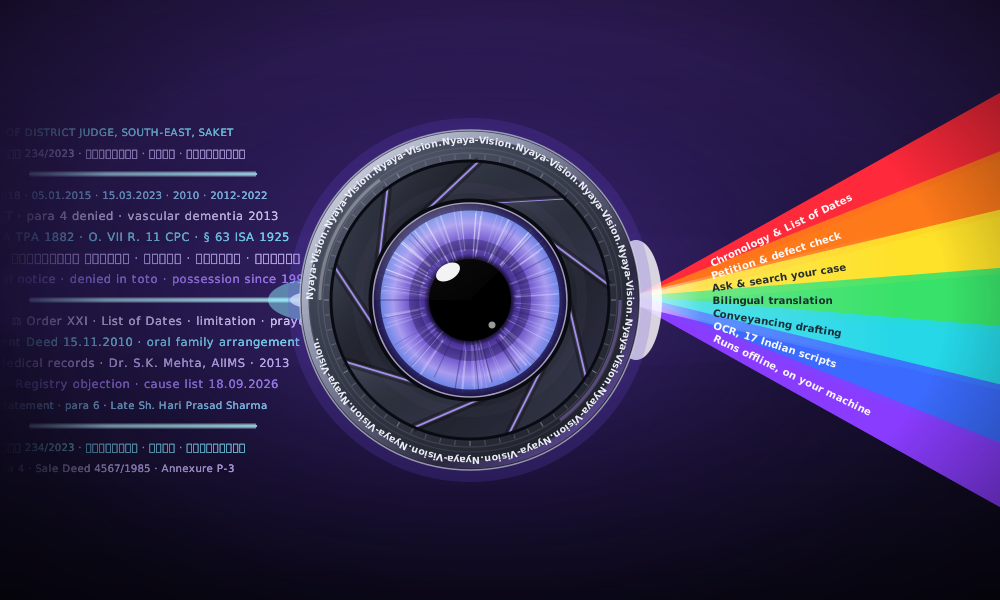
Nyaya-Vision reads the entire bundle, plaint to rejoinder, annexures included, and returns a List of Dates and Events with the source page against each entry. It then answers the questions you would put to a junior who had read the file: what was pleaded, when, and where it says so. It runs on your own machine. The papers do not leave chambers.
What it does
It reads everything, including annexure P-17.
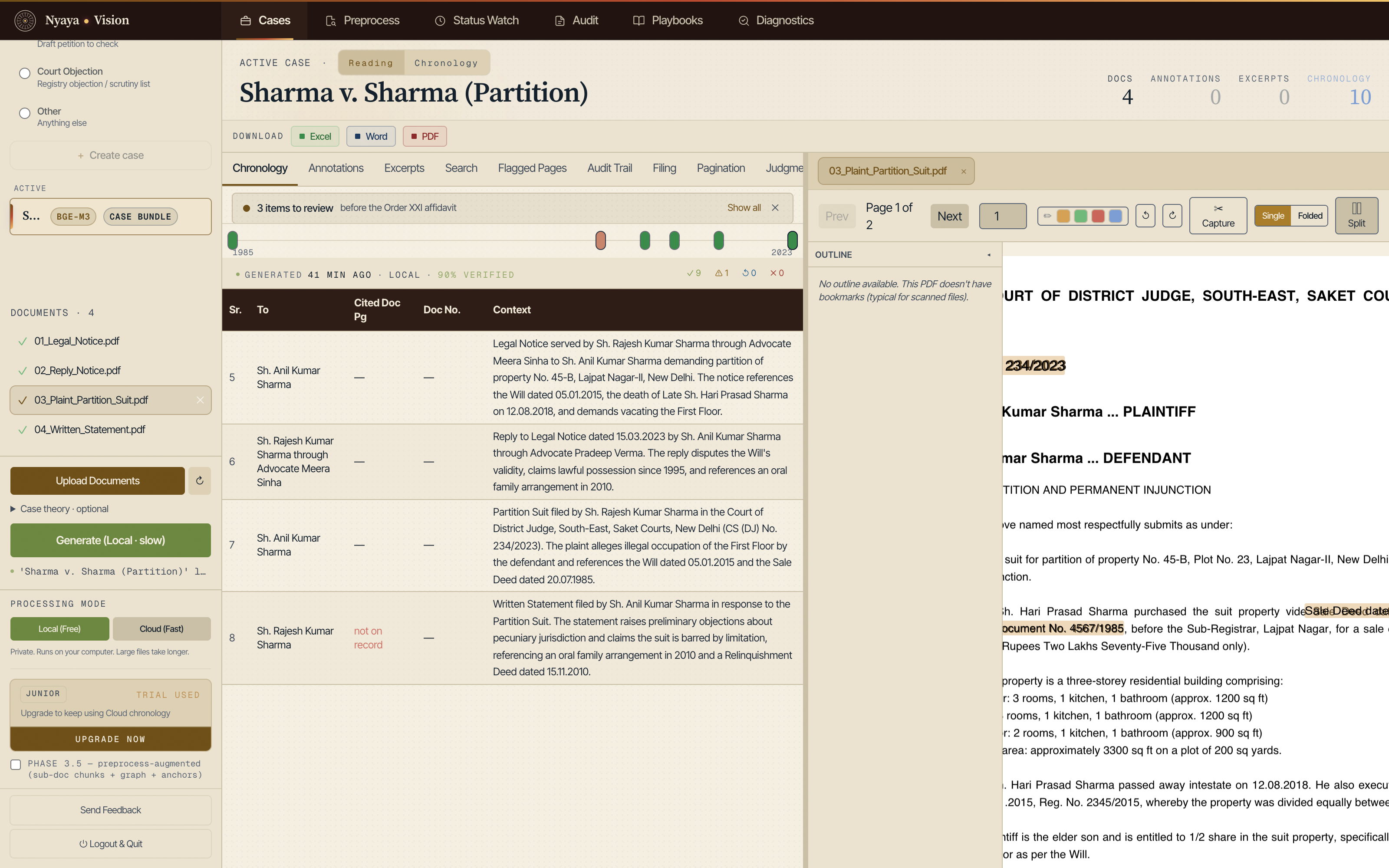
Half the dates that decide a matter sit in annexures nobody reads twice: the demand notice, the reply to it, the office report. The software reads every page, typed or scanned, and lists each event with the document and page it came from. Where two documents give two versions of the same date, both are listed. Which one goes in the synopsis remains your call.
Every answer arrives with the page open.
Ask what the written statement says about possession. You get the paragraph, the page number, and the page itself on screen beside the answer. A junior's summary has to be checked. A citation you can see does not.
Registry objections, before the Registry.
A draft petition is run against rules drawn from the Acts and the practice directions of the forum: the verification affidavit, the index, pagination, the court fee memo, the list of dates. Each defect is listed with the rule that makes it one. This will not make a weak petition strong. It will stop a strong petition from coming back on a Tuesday for want of an index.
The brief stays in chambers.
The models run on your own computer through Ollama. Nothing is uploaded, no account is created, and nobody at the far end of a network reads your client's papers. Confidentiality here is not a setting to be switched on. It is how the thing is built.
A word on error
The machine can be wrong. So can a junior. This one shows its sources.
Language models write confident prose, and confident prose with a wrong date in it is how adverse observations get made. The software is therefore built on one rule: nothing is presented without the page it came from. A chronology entry opens the paragraph. An answer names the document and the page. A defect names the rule.
Where the operative words could not be found on the page, the entry is marked unverified and left in view, not tidied away. What you file is yours. The tool exists to make checking fast, not to make it unnecessary.
Who it is for
Counsel in independent practice
The free edition is the whole workflow, not a sample of it. Install it on the laptop you already carry to court.
Juniors and clerks
The first reading of a fresh brief, which used to take the weekend, takes the morning. The time goes into the second reading, which is the one that matters.
Chambers and firms
Seats for the team, cloud models for bundles that run to thousands of pages, and OCR for regional-language records from the district courts.
Try it on the next brief that lands.
The free edition needs no account and no key. Its chronology covers matters up to 100 pages, and 300 pages a month.